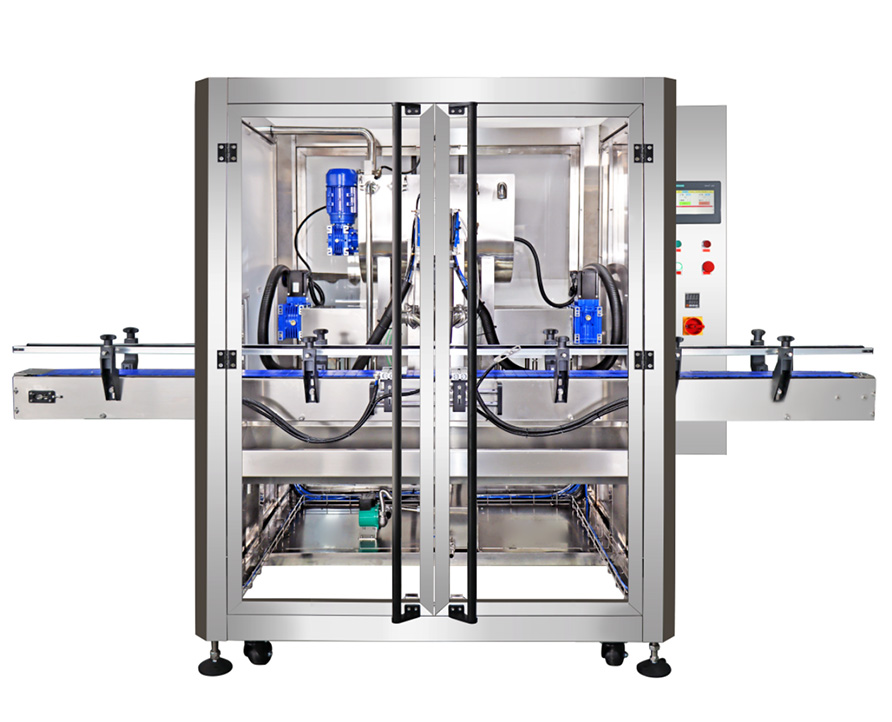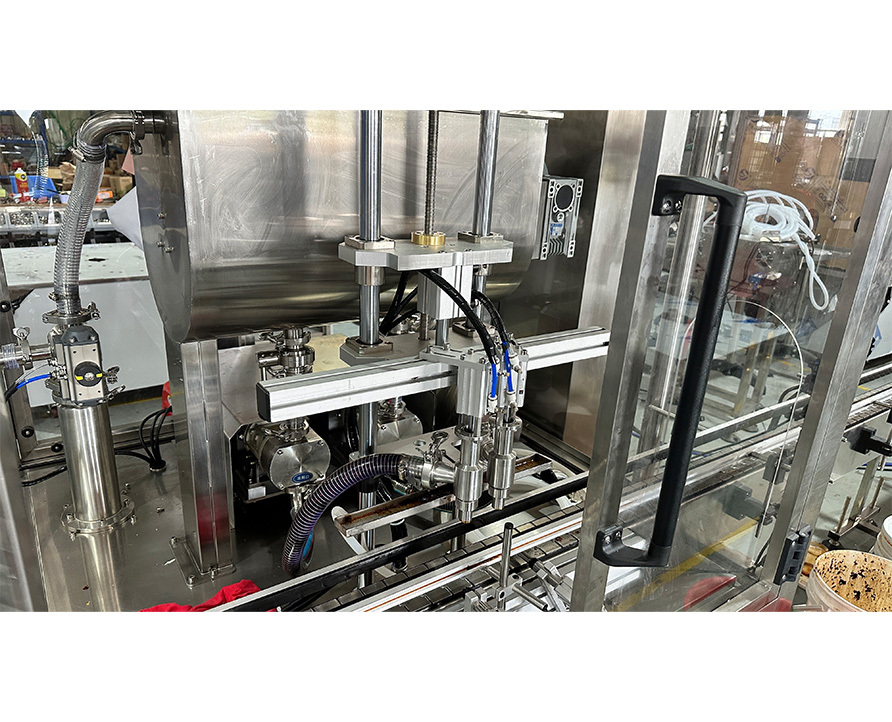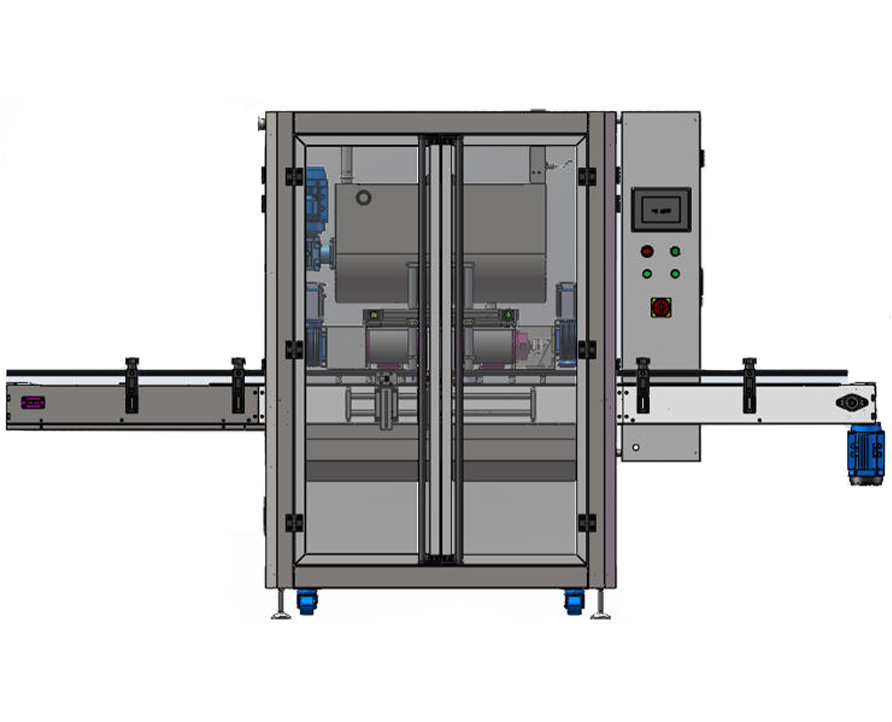



This pastes sauce filling machine uses servo-controlled rotor pumps for automatic, repeatable dosing of sauces, pastes, creams and ghee. The double-head configuration combines Siemens PLC control, SICK sensors, polished 316 filling valves and an enclosed protective cover. Filling-head configurations can be selected to match production requirements. Suitable for food and cosmetic manufacturers; share the product characteristics, fill quantity and container dimensions for configuration assessment.
Servo-controlled quantitative filling with rotor pumps.
Double-head configuration, with other head counts available for project selection.
Siemens PLC control and SICK sensor technology.
Polished 316 filling valves and an enclosed protective cover.
Product Description
This pastes sauce filling machine is a fully automatic double-head rotor pump filler for manufacturers packaging sauces, pastes, creams and ghee. Servo-controlled dosing supports repeatable filling, while Siemens PLC control and SICK sensors provide the control and sensing components for automatic operation. The machine is intended for compatible containers and formulations, with final configuration based on the required fill quantity, product characteristics and production output.
Controlled dosing for production that requires consistent fill quantities.
Two filling heads in the featured configuration.
Polished 316 filling valves designed to limit leakage at the dispensing point.
Enclosed protective cover around the machine operating area.
Filling performance should be assessed with the actual product and container. A change in formulation, operating temperature or container opening can affect the required pump and filling-valve setup.
Variations in fill quantity can create rework, inconsistent package presentation and unnecessary product giveaway. The machine uses servo-controlled quantitative filling to regulate rotor pump operation for each dosing cycle.
The rotor pump transfers product through the filling path, while the servo system controls the dosing movement. The specified filling accuracy must be established for the buyer's formulation and operating conditions rather than assumed from the pump type alone.
Fill quantity: identify the required volume or weight for each container size.
Product condition: provide viscosity information and the intended filling temperature.
Acceptance criteria: define the permissible fill variation before configuration approval.
If the finished package is specified by weight, the dosing assessment should also consider product density and how that density changes under production conditions.
The featured machine has two filling heads. Guangzhou Full Harvest Industries Co., Ltd. offers filling-head configurations such as single-head, double-head, four-head and six-head arrangements according to production requirements.
These are configuration choices for machine selection, not a claim that the delivered double-head unit can switch between all head counts without modification. The required arrangement should be confirmed before ordering.
Specify the required containers per minute for each main product.
Identify the largest fill quantity and the most demanding formulation.
Check the capacity of the downstream seamer, capper or labeling station.
A head-count decision should reflect the complete packaging process. More heads alone do not establish the usable output for a particular product.
The supplied product description specifies 316 material for the filling valves, with a highly polished finish and a leak-resistant design. This is relevant to buyers assessing the dispensing point, product residue and filling-area cleanliness.
The material specification for the pump, hopper, tubing, seals and other product-contact components should be confirmed separately. The stated valve material does not establish the construction of the entire product-contact system.
The machine includes a fully enclosed protective cover. Buyers should confirm the access arrangement for inspection, cleaning, tape-free container handling and routine servicing, together with the final guarding and safety-control specification.
The enclosure does not by itself establish aseptic filling, clean-in-place capability or pharmaceutical compliance. Cleaning procedures, disassembly requirements and any special sanitation provisions should be agreed for the intended application.
The following table separates the supplied machine information from the project-specific values that need confirmation before purchase.
| Specification | Available Information |
|---|---|
| Machine type | Fully automatic rotor pump filling machine |
| Featured filling-head configuration | Double head |
| Dosing control | Servo-controlled quantitative filling |
| PLC | Siemens; exact model to be confirmed in the quotation |
| Sensor brand | SICK; exact model and sensing functions to be confirmed |
| Filling-valve material | 316 material with a polished finish |
| Protective structure | Fully enclosed protective cover |
| Intended products | Compatible pastes, sauces, creams and ghee |
| Container compatibility | Different container specifications and shapes, subject to dimensional and handling assessment |
| Alternative head configurations | Single, double, four and six heads described; final arrangement subject to project confirmation |
| Filling range and accuracy | Numerical values to be confirmed for the selected configuration and product |
| Production capacity | To be confirmed against fill quantity, formulation and container format |
| Power supply, utilities and dimensions | To be specified in the final technical proposal |
| MOQ, lead time and export packing | To be confirmed in the commercial quotation |
| Testing and certification documents | Availability and applicable scope to be confirmed before ordering |
Guangzhou Full Harvest Industries Co., Ltd. can review the filling-head arrangement and packaging-line requirements for the buyer's project. The proposal should distinguish the selected machine configuration from any additional engineering work.
Head count: select the arrangement against the required production output.
Container range: provide opening diameter, body dimensions, height and material.
Fill requirement: identify minimum and maximum fill quantities across the proposed product range.
Line connection: provide the upstream and downstream equipment layout.
Container compatibility should be checked against the actual drawings or samples. A machine described as suitable for different shapes still needs confirmation of container positioning and access to the opening.
Requests for heating, agitation, particle handling, special seals, clean-in-place cleaning or additional control functions should be listed separately. These features are not established as standard equipment by the supplied product information.
For ghee or temperature-sensitive formulations, include the required filling temperature and whether the product remains pumpable during the full production cycle.
The machine is intended for production environments that need controlled filling of compatible viscous products into containers.
Sauce producers filling smooth formulations with defined viscosity and fill requirements.
Food manufacturers packaging pumpable pastes into compatible cans or containers.
Ghee processors working with a specified product temperature and container format.
Cosmetic manufacturers filling creams or emulsions after compatibility assessment.
Products containing particles, highly abrasive ingredients or unusual chemical components need a separate assessment. Pharmaceutical applications also require confirmation of the necessary materials, cleaning provisions and documentation; general filling suitability should not be treated as regulatory approval.
This is an illustrative procurement scenario, not a documented customer installation. A sauce manufacturer plans an automatic filling station for two smooth formulations packed in different can sizes.
The buyer needs repeatable dosing across both products, a configuration matched to the existing closing station, and a defined cleaning procedure between production runs. The available production space and container-opening dimensions also limit the machine arrangement.
For this scenario, Guangzhou Full Harvest Industries Co., Ltd. would assess the double-head rotor pump configuration against the formulations, filling temperatures, fill quantities and container drawings. The technical proposal would identify the selected head arrangement, filling-valve specification and line interfaces, while separating any additional cleaning or temperature-control requirements from the base machine.
The procurement deliverable would be an agreed configuration and acceptance checklist covering fill variation, usable output, container handling and changeover requirements. Actual operating results would need confirmation through agreed product trials or acceptance testing; no measured production improvement is claimed in this example.
It is intended for compatible pastes, sauces, creams and ghee. Suitability depends on viscosity, filling temperature, particles and the required dose. Provide the formulation characteristics before selecting the pump and filling-valve arrangement.
The supplied information describes accurate, stable servo-controlled dosing but does not provide numerical specifications. Request the filling tolerance and usable output for the actual product, fill quantity and container.
The confirmed 316 specification applies to the filling valves. Materials for the pump, tubing, hopper, seals and other wetted components should be listed in the final technical specification.
Particle-handling capability is not confirmed in the supplied information. Provide the maximum particle size, particle concentration and ingredient characteristics for assessment before ordering.
Other head counts are available as configuration choices. Conversion of an existing double-head machine is a separate engineering question and should not be assumed to be a standard adjustment.
Neither function is confirmed as standard. Specify the required operating temperature and cleaning method so their feasibility and effect on the quotation can be evaluated.
Discuss sample-testing availability, required sample quantity, container samples and acceptance criteria before shipment. Test scheduling and any associated charges need confirmation with Guangzhou Full Harvest Industries Co., Ltd.
MOQ and lead time are not stated in the supplied product information. Both should be confirmed in the quotation after the machine configuration, order quantity and destination requirements are defined.
Guangzhou Full Harvest Industries Co., Ltd. designs, manufactures and supplies can packaging equipment, including filling machines, can seamers, capping machines and labeling machines. For paste and sauce projects, the company combines the filling-station assessment with container-closing and downstream packaging requirements. Its business includes research and development, design, production and sales for food, beverage, pharmaceutical and chemical packaging applications.
For a configuration-specific quotation, please provide the following production details through the existing inquiry form:
Product: formulation type, viscosity if known, filling temperature and any particles.
Fill quantity: target volume or weight and acceptable filling tolerance.
Containers: material, opening size, body dimensions, height and photos or drawings.
Production target: required containers per minute and preferred head configuration, if known.
Installation: destination, available power supply and existing line layout.
Order scope: machine quantity, cleaning requirements and any requested testing or documentation.
Guangzhou Full Harvest Industries Co., Ltd. can use these details to assess the proposed filling configuration and identify the technical and commercial items requiring confirmation.
No.3 Gongye South Road,Mingzhu Industrial Park,Conghua District ,Guangzhou City 510900,China
+86 20 3751 0321
FOLLOW US


Tel/ Fax: +86 20 3751 0321
E-mail: sales@gzfharvest.com
Add: No.3 Gongye South Road,Mingzhu Industrial Park,Conghua District ,Guangzhou City 510900,China