

Nov. 28, 2026
With the growing demand for packaged coffee products, coffee manufacturers need reliable and efficient packaging equipment to improve production capacity, maintain consistent filling weights and protect product quality.
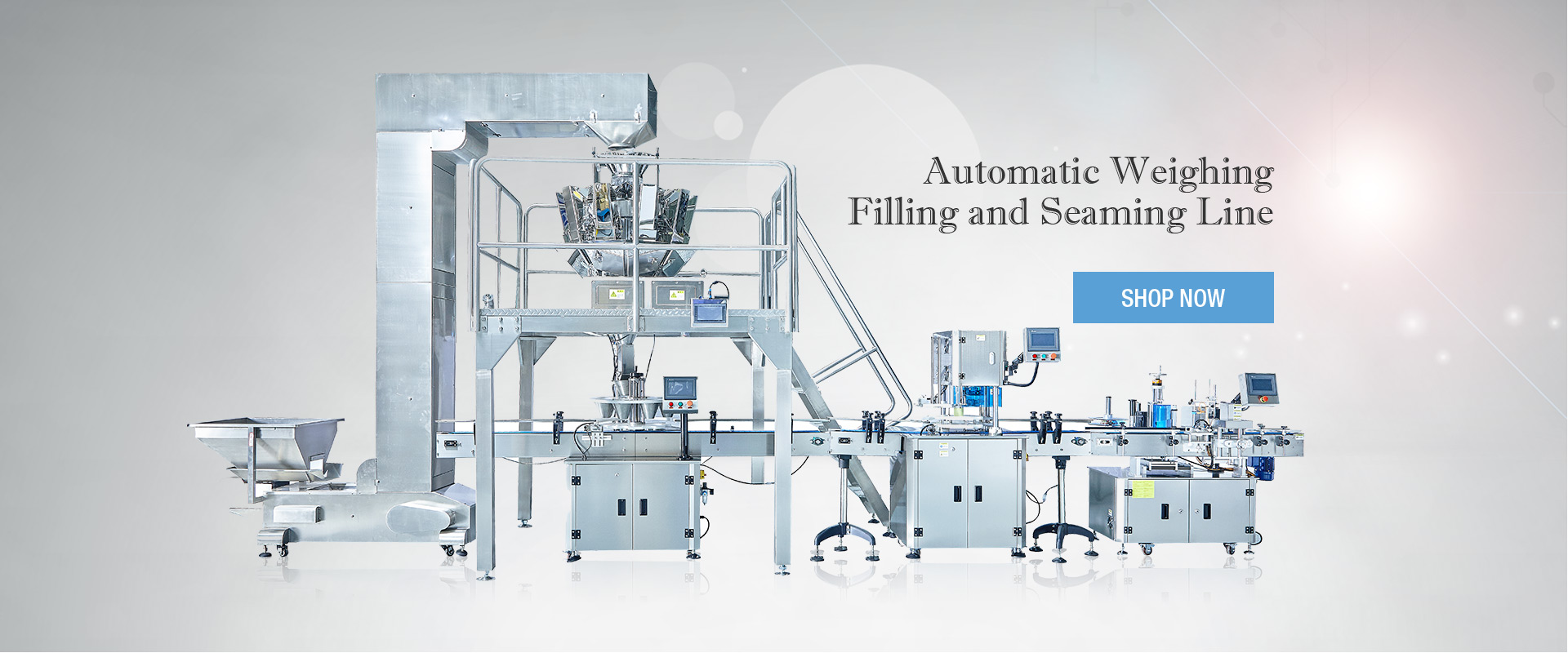
An automatic coffee bean packaging line integrates weighing, filling, can seaming or capping, inspection and labeling equipment into a coordinated production system.
GZFHARVEST provides customized coffee bean packaging solutions for different production capacities, container types and preservation requirements. From low-speed linear weighing and filling systems to high-speed multihead weighing machines, standard can seamers and vacuum nitrogen flushing can sealing machines, manufacturers can select the appropriate equipment configuration according to their production requirements.
This article explains how to select the right coffee bean weighing machine, filling system, can seamer, capping machine and auxiliary packaging equipment for a complete automatic coffee bean packaging line.
1. Coffee Bean Packaging Line Configuration: From Weighing to Final Packaging
A complete coffee bean packaging line can include the following equipment:
Automatic coffee bean feeding system
Linear weighing machine or multihead combination weigher
Automatic can or bottle filling machine
Standard can seaming machine or vacuum nitrogen flushing can seamer
Automatic screw capping machine
Metal detector
Checkweigher
Electromagnetic induction foil sealing machine
Bottle body labeling machine
Cap top labeling machine
The actual configuration depends on the coffee product, target filling weight, container specifications, required production speed and packaging preservation method.
For example, coffee beans packaged in metal cans may require a weighing and filling machine followed by a can seamer. Coffee beans packed in plastic or glass jars may require a weighing and filling machine, screw capping machine and induction foil sealing machine.
For manufacturers requiring higher production capacity, multiple weighing heads and multi-head capping systems can be integrated to improve overall line efficiency.
2. Coffee Bean Weighing and Filling Machine: Linear Weigher vs. Multihead Weigher
Choosing the correct weighing system is one of the most important decisions when designing a coffee bean packaging line.
Different production capacities require different weighing technologies. For manufacturers with relatively low production speed requirements, a linear weighing machine can be an economical solution. For higher-speed production, a multihead combination weigher is generally more suitable.
Option A: 4-Head Linear Weighing and Filling Machine
A 4-head linear weigher is suitable for small and medium-scale coffee bean packaging applications where production speed requirements are relatively moderate.
The machine uses vibrating feeding channels to distribute coffee beans into individual weighing hoppers. Load cells measure the weight of the product, and the control system operates the discharge mechanism when the preset target weight is reached.
Main components:
Product storage hopper
Vibrating feeding channels
Four weighing hoppers
High-precision load cells
PLC or weighing control system
Automatic discharge mechanism
Working principle:
Coffee beans are transferred from the storage hopper to the vibrating feeding channels. Each channel feeds product into its corresponding weighing hopper. The weighing controller monitors the weight signals and controls the feeding and discharging process to achieve the preset target weight.
Advantages:
Relatively simple machine structure
Easy operation and maintenance
Suitable for small and medium production requirements
Adjustable target filling weight
Cost-effective solution for lower-speed packaging lines
A 4-head linear weigher is a practical choice for coffee manufacturers who do not require extremely high production speeds.
Option B: Multihead Combination Weigher for High-Speed Coffee Bean Packaging
For coffee manufacturers requiring higher production capacity, a multihead combination weigher is a more suitable option.
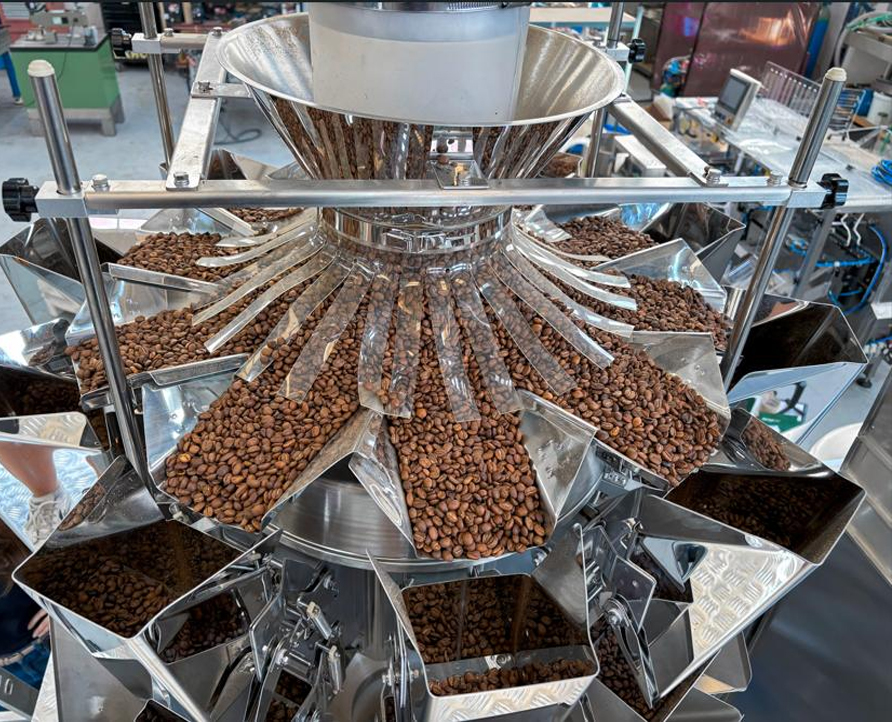
GZFHARVEST can configure different multihead weighing systems according to the required output, including:
10-Head Multihead Weigher
Suitable for production lines requiring higher weighing efficiency than a basic linear weighing system.
14-Head Multihead Weigher
Provides more weighing combinations and is suitable for medium-to-high-speed packaging applications.
20-Head Multihead Weigher
Designed for applications requiring more weighing combinations and higher production capacity, depending on the product, target weight and container handling system.
How Does a Multihead Weigher Work?
A multihead weigher uses multiple independent weighing hoppers to calculate different combinations of product weights.
The basic working process includes:
Coffee beans enter the central product distribution system.
Vibrating feeders distribute the beans to individual weighing hoppers.
Load cells measure the weight in each hopper.
The control system calculates available weight combinations.
The system selects the combination closest to the preset target weight.
The selected hoppers discharge their product into the packaging container.
Compared with a conventional linear weighing system, a multihead combination weigher can use multiple weighing combinations to improve weighing efficiency and reduce unnecessary product giveaway.
How to Choose Between Linear and Multihead Weighing Machines?
Equipment | Suitable Production Requirement | Main Advantage |
4-Head Linear Weigher | Low to medium speed | Simple structure and economical investment |
10-Head Multihead Weigher | Higher-speed production | More weighing combinations |
14-Head Multihead Weigher | Medium to high-speed production | Flexible combination weighing |
20-Head Multihead Weigher | Higher-capacity production | More weighing combinations and greater production potential |
The actual output depends on target weight, coffee bean characteristics, feeding stability, container size and downstream machine speed.
3. Automatic Can Seaming Machine: Different Solutions for Different Production Speeds
After weighing and filling, coffee beans are transferred to the can sealing station.
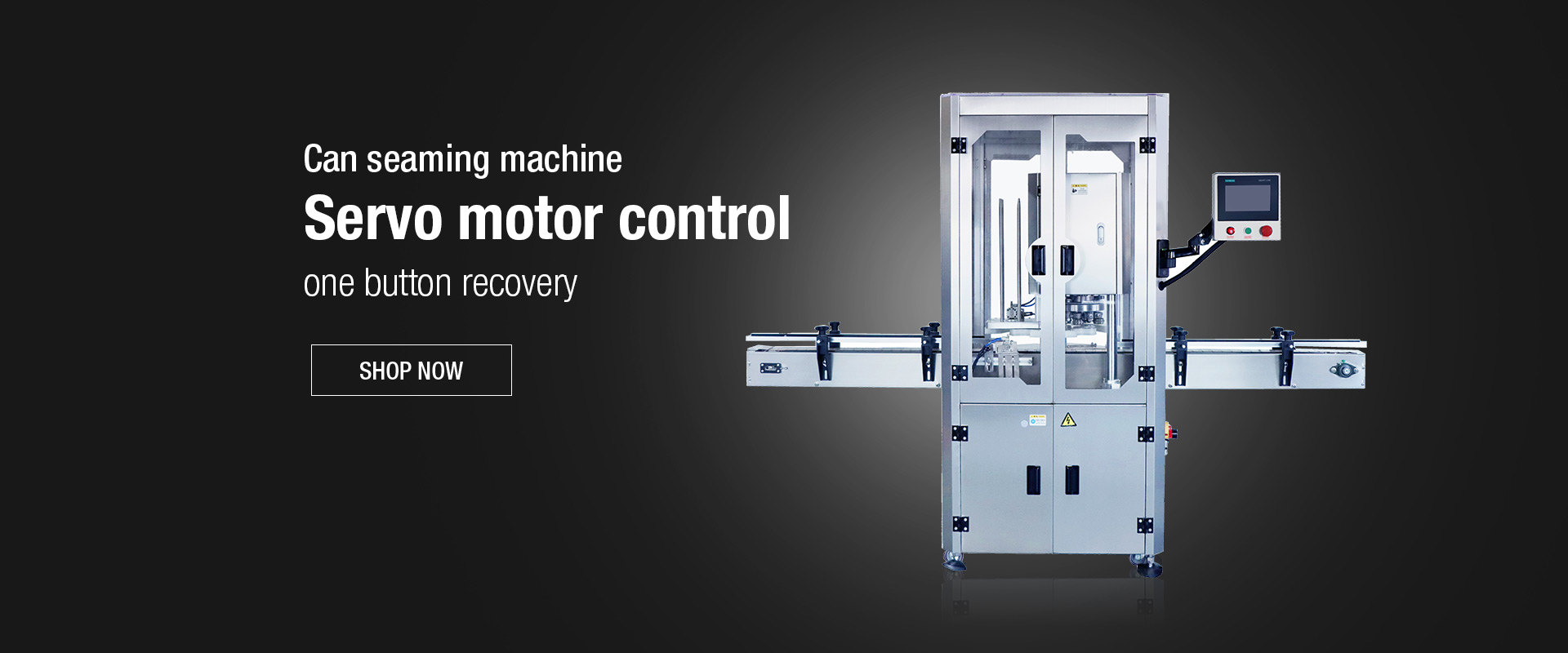
For metal cans and compatible can structures, an automatic can seaming machine mechanically joins the can body and can end through a double-seaming process.
The appropriate can seamer should be selected according to the required production speed, can dimensions and whether nitrogen flushing or vacuum nitrogen flushing is required.
Option A: Standard Automatic Can Seamer
For conventional coffee bean packaging without vacuum or nitrogen flushing, a standard automatic can seaming machine is a practical solution.
GZFHARVEST offers different configurations according to production requirements:
Single-Head Can Seamer
Production speed: approximately 20–50 cans per minute.
Suitable for small and medium-scale production.
Compact equipment configuration.
Suitable for different metal can,aluminum cans,paper cans ,and plastic jar specifications with corresponding tooling.
Double-Head Can Seamer
Production speed: approximately 50–80 cans per minute.
Suitable for higher-capacity packaging lines.
Designed to increase can sealing output.
Can be integrated with automatic weighing and filling systems.
The actual output depends on can diameter, can height, container feeding stability and machine configuration.
Option B: Nitrogen Flushing Can Seaming Machine
For roasted coffee beans, oxygen exposure can accelerate the deterioration of aroma and flavor.
Nitrogen flushing technology introduces nitrogen gas into the can before sealing to displace part of the oxygen-containing air.
This helps reduce residual oxygen inside the container and provides a more protective packaging atmosphere.
Typical nitrogen flushing can seamer configuration:
Production speed: approximately 20–25 cans per minute.
Nitrogen gas injection before can sealing.
Suitable for coffee beans and other oxidation-sensitive food products.
Can be integrated into an automatic weighing and filling line.
Nitrogen flushing is especially useful for coffee manufacturers who want to improve product protection during storage and transportation.
Option C: Vacuum Nitrogen Flushing Can Seamer
For coffee packaging applications requiring more intensive air removal, a vacuum nitrogen flushing can seamer can be considered.
The machine removes air from the can through a vacuum system and then introduces nitrogen gas before completing the sealing process.
This process can help achieve a lower residual oxygen level than conventional nitrogen flushing under suitable operating conditions.
GZFHARVEST offers the following configurations:
Single-Head Vacuum Nitrogen Flushing Can Seamer
Production speed: approximately 4–6 cans per minute.
Suitable for small-scale production.
Designed for applications requiring vacuum and nitrogen flushing.
Double-Head Vacuum Nitrogen Flushing Can Seamer
Production speed: approximately 8–10 cans per minute.
Suitable for higher output requirements within vacuum nitrogen packaging applications.
Combines vacuum air removal, nitrogen injection and can sealing.
The actual residual oxygen level depends on the vacuum cycle, nitrogen flushing parameters, can geometry, product degassing and sealing performance.
Comparison of Coffee Bean Can Seaming Solutions
Can Seaming Machine | Typical Speed | Packaging Process |
Single-Head Standard Can Seamer | 20–50 | Standard double seaming |
Double-Head Standard Can Seamer | 50–80 cans/min | Standard double seaming |
Nitrogen Flushing Can Seamer | 20–25 cans/min | Nitrogen flushing + sealing |
Single-Head Vacuum Nitrogen Seamer | 4–6 cans/min | Vacuum + nitrogen + sealing |
Double-Head Vacuum Nitrogen Seamer | 8–10 cans/min | Vacuum + nitrogen + sealing |
production output should be confirmed according to can specifications, filling weight and process requirements.
4. Coffee Bean Capping Machine: Single-Head, Double-Head, 3-Head and 4-Head Options
Not all coffee products are packaged in metal cans. Some manufacturers use plastic jars, PET bottles or glass containers with screw caps.
In these applications, an automatic screw capping machine can be integrated after the weighing and filling station.
GZFHARVEST provides different capping configurations to match different production speeds.
Single-Head Capping Machine
Suitable for lower-speed packaging lines and smaller production requirements.
Double-Head Capping Machine
Suitable for medium-speed production and higher output requirements.
3-Head Capping Machine
Designed for production lines requiring increased capping efficiency.
4-Head Capping Machine
Suitable for higher-speed packaging applications where multiple capping heads are required.
The number of capping heads should be selected according to the required production speed, cap dimensions, container type and cap feeding method.
An automatic cap elevator and cap sorting system can also be added to provide continuous cap feeding and reduce manual operation.
5. Optional Inspection and Auxiliary Packaging Equipment
To improve packaging quality, production stability and automation, additional inspection and packaging equipment can be integrated into the coffee bean production line.
5.1 Metal Detector
A metal detector can be installed at a suitable point in the production process to detect potential metal contamination.
Depending on the product and packaging configuration, it can be installed before filling or after packaging using a suitable detection system.
This equipment helps improve food safety and quality control.
5.2 Automatic Checkweigher
A checkweigher automatically measures the weight of finished packages after filling.
Packages outside the preset weight tolerance can be automatically rejected through a rejection mechanism.
This helps manufacturers monitor filling consistency and reduce underweight or overweight products.
5.3 Electromagnetic Induction Foil Sealing Machine
For plastic and glass containers with compatible aluminum foil liners, an electromagnetic induction sealing machine can be installed after screw capping.
The induction process heats the aluminum foil liner through electromagnetic induction, bonding it to the container opening to create an additional sealing layer.
Benefits include:
Improved container sealing performance.
Additional protection against moisture and external contamination.
Tamper-evident packaging when an appropriate liner is used.
Compatibility with suitable plastic and glass containers.
5.4 Bottle Body Labeling Machine
An automatic bottle body labeling machine applies self-adhesive labels to the side of coffee bean containers.
It is suitable for round, square and other compatible bottle shapes, depending on the labeling machine configuration.
5.5 Cap Top Labeling Machine
A cap top labeling machine applies labels to the top surface of container caps.
It can be used for brand identification, product information or packaging design requirements.
Both bottle body labeling and cap top labeling can be integrated into the final packaging section.
6. How to Configure a Complete Automatic Coffee Bean Packaging Line?
Different coffee manufacturers have different production targets and packaging requirements. Therefore, a complete production line should be configured according to the required output and packaging method.
The following are typical configuration examples.
Solution 1: Low-Speed Coffee Bean Can Packaging Line
Recommended for manufacturers with relatively low production requirements.
Equipment configuration:
4-head linear weighing machine
Automaic can filling machine
Single-head standard can seamer
Bottle or can body labeling machine
Process:
Product Feeding → Linear Weighing → Can Filling → Can Seaming → Labeling
This configuration is suitable for small and medium-scale coffee bean packaging operations.
Solution 2: High-Speed Coffee Bean Can Packaging Line
Recommended for manufacturers requiring higher packaging capacity.
Equipment configuration:
10-head, 14-head or 20-head multihead combination weigher
Automatic can filling system
Double-head standard can seamer
Automatic checkweigher
Metal detector
Automatic labeling machine
Process:
Product Feeding → Multihead Combination Weighing → Can Filling → Inspection → Double-Head Can Seaming → Labeling
The number of weighing heads and the can seaming configuration should be selected according to the required line output.
Solution 3: Coffee Bean Nitrogen Flushing Packaging Line
Recommended for roasted coffee beans requiring reduced oxygen exposure.
Equipment configuration:
Linear weigher or multihead combination weigher
Automatic can filling machine
Nitrogen flushing can seamer
Checkweigher
Labeling machine
Process:
Product Weighing → Can Filling → Nitrogen Flushing → Can Seaming → Weight Inspection → Labeling
This solution helps reduce oxygen inside the package and protect coffee quality during storage.
Solution 4: Coffee Bean Vacuum Nitrogen Flushing Packaging Line
Recommended for coffee manufacturers requiring vacuum air removal and nitrogen protection.
Equipment configuration:
Automatic weighing and filling machine
Single-head or double-head vacuum nitrogen flushing can seamer
Can conveying system
Finished product inspection
Automatic labeling equipment
Process:
Product Weighing → Can Filling → Vacuum Air Removal → Nitrogen Injection → Can Seaming → Finished Product Inspection
This configuration is suitable for specialized coffee packaging applications where lower residual oxygen is required.
Solution 5: Coffee Bean Jar Filling and Capping Line
For manufacturers using plastic or glass jars instead of metal cans.
Equipment configuration:
Linear weighing or multihead combination weigher
Automatic jar filling machine
Single-head, double-head, 3-head or 4-head capping machine
Metal detector
Automatic checkweigher
Electromagnetic induction foil sealing machine
Bottle body labeling machine
Cap top labeling machine
Process:
Jar Feeding → Weighing → Filling → Capping → Induction Foil Sealing → Inspection → Body Labeling → Cap Top Labeling
This configuration provides a flexible solution for coffee bean packaging in different jar formats.
7. How to Select the Right Coffee Bean Packaging Line?
Before purchasing a coffee bean packaging machine, manufacturers should evaluate the following technical parameters:
Selection Factor | Information Required |
Product | Roasted coffee beans, green coffee beans or other coffee products |
Filling Weight | 100 g, 250 g, 500 g, 1 kg or customized |
Container Type | Tin can, aluminum can, PET jar or glass bottle |
Container Dimensions | Diameter, height and opening size |
Production Capacity | Required containers per minute |
Weighing System | Linear weigher or multihead combination weigher |
Sealing Method | Standard seaming, nitrogen flushing or vacuum nitrogen flushing |
Closure Type | Metal can end or screw cap |
Additional Equipment | Metal detector, checkweigher, induction sealer and labeling machines |
The most suitable packaging solution is not necessarily the machine with the highest speed or the largest number of weighing heads.
Instead, the equipment should be selected according to the actual production target, packaging quality requirements, available factory space and investment budget.
The weighing machine, filling station, seaming or capping machine and downstream inspection equipment must also be properly synchronized to avoid production bottlenecks.
8. GZFHARVEST: Customized Automatic Coffee Bean Packaging Solutions
GZFHARVEST is a professional packaging machinery manufacturer specializing in weighing and filling machines, automatic can seaming machines, vacuum nitrogen flushing can seamers, capping machines, labeling machines and complete packaging production lines.
For coffee bean manufacturers, GZFHARVEST provides flexible equipment configurations for different production speeds and packaging requirements.
Whether you need a 4-head linear weighing and filling machine for lower-speed production, a 10-head, 14-head or 20-head multihead weigher for higher-speed production, or a complete can packaging line with nitrogen flushing and vacuum sealing technology, our engineering team can help configure a suitable solution.
We also provide optional metal detectors, checkweighers, electromagnetic induction foil sealing machines, bottle body labeling machines and cap top labeling machines to create a more integrated packaging process.
Looking for an automatic coffee bean packaging line?
Contact GZFHARVEST to discuss your product, target filling weight, container specifications and required production capacity.
Our team can recommend a suitable weighing, filling, can seaming or capping configuration for your coffee packaging project.
Frequently Asked Questions About Coffee Bean Packaging Lines
Q1: What is the difference between a linear weigher and a multihead weigher for coffee beans?
A: A linear weigher uses individual vibrating feeding channels and weighing hoppers to achieve the target weight. It is suitable for relatively low-speed production. A multihead combination weigher uses multiple weighing hoppers to calculate different weight combinations and is generally suitable for higher-speed production.
Q2: How many weighing heads are available for automatic coffee bean packaging?
A: Common configurations include 4-head linear weighing machines and 10-head, 14-head and 20-head multihead combination weighers. The appropriate model depends on target weight, product flow characteristics and required production capacity.
Q3: What is the production speed of a coffee bean can seaming machine?
A: A standard single-head can seamer typically operates at 20–50 cans per minute, while a double-head configuration typically operates at 50–80 cans per minute. Actual speed depends on container specifications and machine configuration.
Q4: What is the difference between nitrogen flushing and vacuum nitrogen flushing?
A: Nitrogen flushing introduces nitrogen gas into the container to displace part of the air before sealing. Vacuum nitrogen flushing first removes air through a vacuum system and then introduces nitrogen before sealing. Vacuum nitrogen flushing can achieve lower residual oxygen under suitable operating conditions.
Q5: What is the speed of a vacuum nitrogen flushing can seamer?
A: A single-head vacuum nitrogen flushing can seamer typically operates at 4–6 cans per minute, while a double-head model typically operates at 8–10 cans per minute.
Q6: Can a coffee bean packaging line include metal detection and checkweighing?
A: Yes. Metal detectors and automatic checkweighers can be integrated into suitable positions in the packaging process to improve contamination detection and finished-package weight control.
Q7: Can the coffee bean packaging line handle both metal cans and plastic jars?
A: Yes, but the closure and sealing equipment must be selected according to the container type. Metal cans generally require a can seaming machine, while compatible plastic or glass jars can use screw capping and optional electromagnetic induction foil sealing.
Q8: Can GZFHARVEST customize a complete coffee bean packaging production line?
A: Yes. GZFHARVEST can customize weighing, filling, can seaming, vacuum nitrogen flushing, capping, inspection and labeling equipment according to the customer's production capacity, packaging materials and container specifications.
No.3 Gongye South Road,Mingzhu Industrial Park,Conghua District ,Guangzhou City 510900,China
+86 20 3751 0321
FOLLOW US


Tel/ Fax: +86 20 3751 0321
E-mail: sales@gzfharvest.com
Add: No.3 Gongye South Road,Mingzhu Industrial Park,Conghua District ,Guangzhou City 510900,China