


Nov. 21, 2026
Introduction
The global demand for packaged nuts and healthy snacks continues to create opportunities for food manufacturers, nut processors, and snack packaging companies. Products such as peanuts, almonds, cashews, pistachios, walnuts, sunflower seeds, and mixed nuts are widely sold in supermarkets, retail stores, food service channels, and online markets.
For nut manufacturers, achieving accurate filling weights, maintaining product appearance, reducing product breakage, and improving packaging efficiency are essential production requirements.
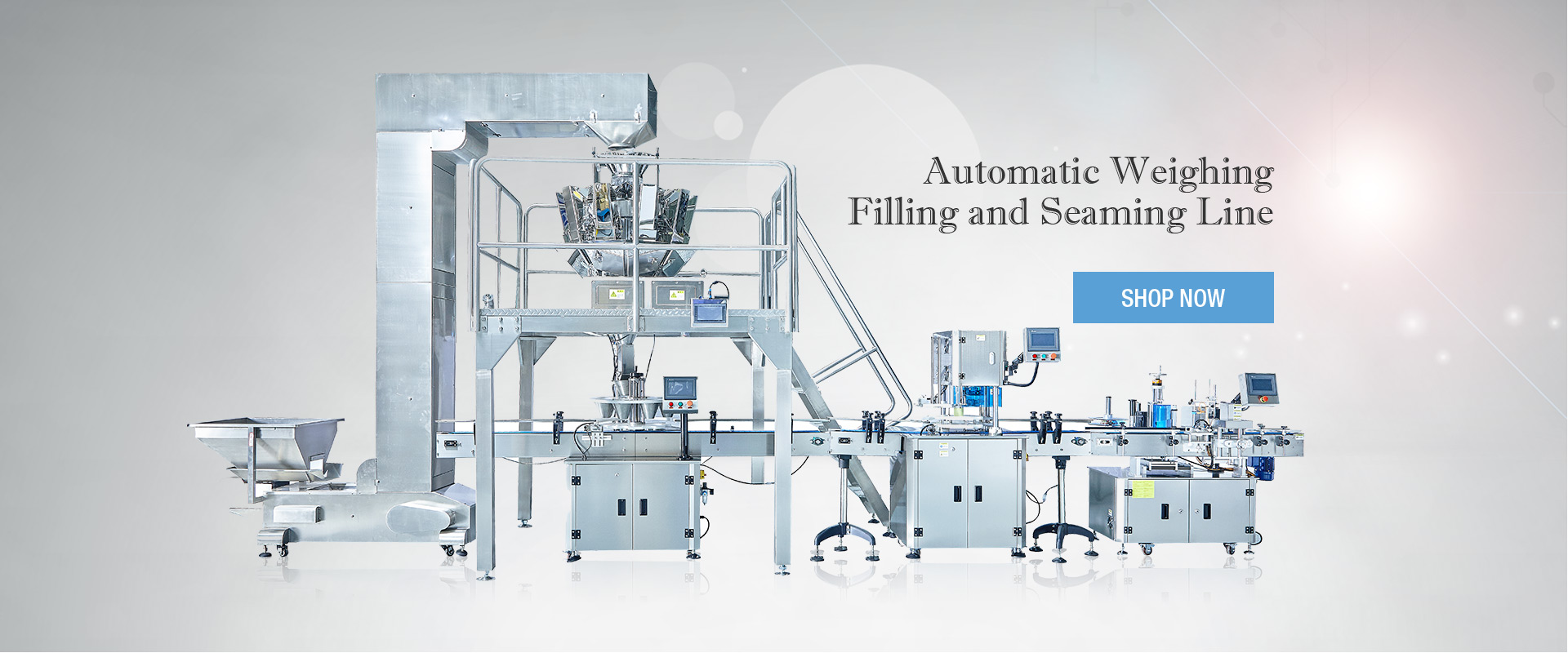
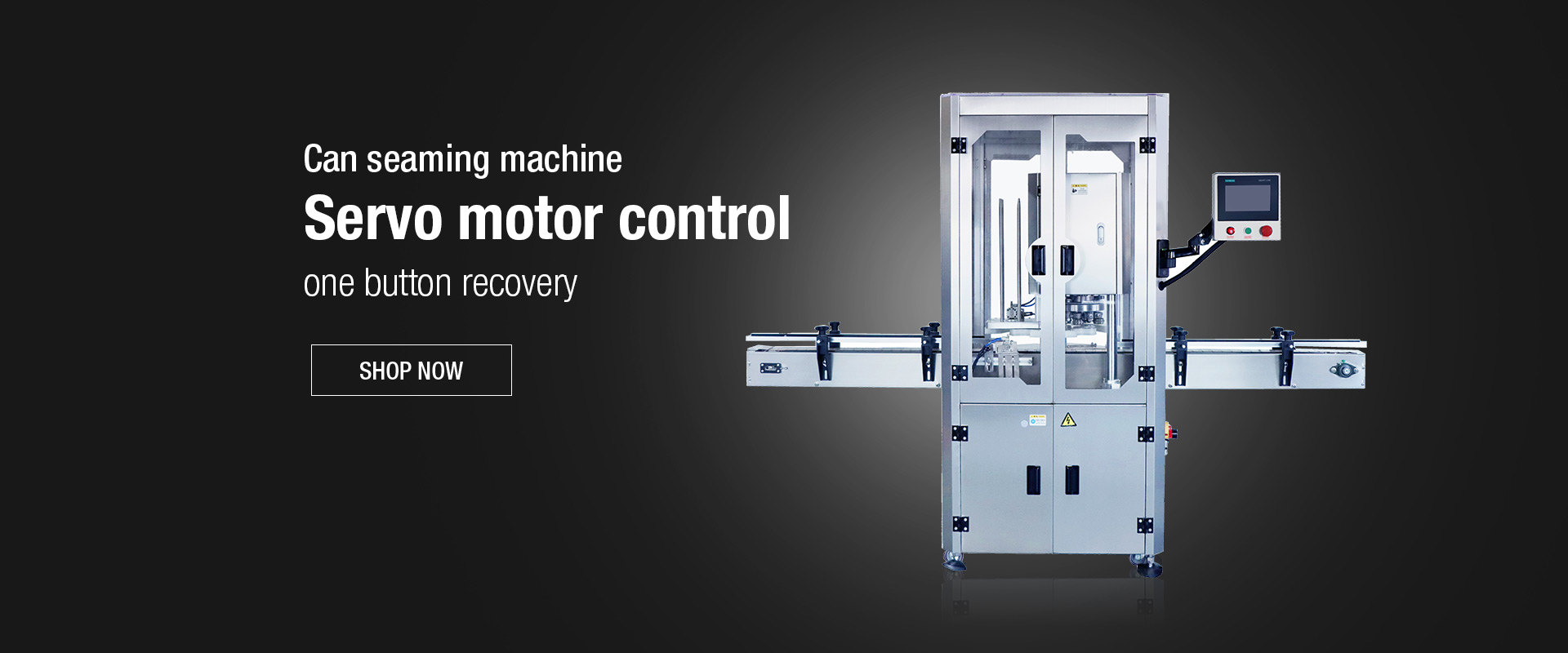
An automatic nut filling machine provides an efficient solution by combining product feeding, automatic weighing, portion control, and container filling. Depending on the packaging format, the filling system can be integrated with a bag packaging machine, can seamer, capping machine, labeling machine, and other downstream equipment.
However, different nuts have different physical characteristics. Peanuts are relatively small and free-flowing, almonds are elongated and relatively hard, cashews have curved shapes, and walnuts may contain large irregular pieces. These differences affect feeding stability, weighing performance, discharge design, and product protection.
This technical guide explains how automatic nut filling machines work, compares different weighing technologies, discusses packaging solutions for different nut products, and provides practical guidance for selecting a suitable automatic nut weighing and packaging line.
1. What Is an Automatic Nut Filling Machine?
An automatic nut filling machine is an industrial packaging machine designed to measure and dispense a predetermined quantity of nuts into bags, pouches, bottles, jars, metal cans, plastic containers, or other packaging formats.
Most modern automatic nut filling systems use electronic weighing technology to control the filling quantity.
Unlike manual scooping or fixed-volume dosing, an electronic weighing system measures the actual product weight before releasing it into the package. This helps manufacturers maintain consistent package weights and reduce unnecessary product giveaway.
A complete automatic nut filling machine may consist of the following components:
1. Product Storage Hopper
Stores raw or processed nuts before they enter the feeding system. Hopper capacity and shape should be selected according to production capacity and product flow characteristics.
2. Product Feeding Conveyor
Transfers nuts from the storage hopper to the weighing machine. Common feeding solutions include Z-type bucket elevators, inclined bucket elevators, and other controlled feeding systems.
3. Product Distribution System
Distributes the nuts evenly to the weighing channels. Vibrating feeding channels are commonly used to regulate material flow.
4. Electronic Weighing System
Measures the actual weight of the nuts using load cells and a weighing controller.
5. Weighing Hoppers
Temporarily hold measured portions of product before discharge.
6. Discharge Chute
Guides the weighed nuts into the target container or packaging machine.
7. PLC Control System
Coordinates feeding, weighing, discharging, container detection, and communication with other packaging equipment.
8. Human-Machine Interface (HMI)
Allows operators to set target weights, adjust feeding parameters, select product recipes, and monitor machine operation.
For different nut products, the machine can be configured with suitable feeding channels, hopper shapes, vibration settings, and discharge structures.
2. How Does an Automatic Nut Filling Machine Work?
An automatic nut filling machine generally operates through a continuous process of feeding, distribution, weighing, combination calculation, and discharge.
The following explains the working principle of a typical multihead weighing nut filling system.
Step 1: Automatic Product Feeding
Nuts are transferred from the storage hopper into the weighing machine through an automatic elevator.
A Z-type bucket elevator is commonly used because it can lift peanuts, almonds, cashews, and other granular or piece-shaped products to the required feeding height.
The elevator should provide stable and controlled material delivery to prevent excessive product accumulation or interruptions in the weighing process.
Step 2: Product Distribution
After entering the weighing machine, the nuts fall onto a central distribution cone.
The cone distributes the products toward multiple radial vibrating feeding channels.
Each channel uses controlled vibration to move the nuts toward its corresponding storage hopper.
The vibration intensity and feeding time can be adjusted according to the product's size, shape, weight, and flow characteristics.
For example:
Peanuts generally require stable and relatively continuous feeding.
Whole almonds require feeding channels that accommodate their elongated shape.
Cashews may require optimized vibration and discharge settings to prevent unnecessary impact.
Walnut halves and large nut pieces may require wider channels and carefully designed hopper openings.
Step 3: Temporary Product Storage
The product enters individual storage hoppers, also known as pool hoppers.
These hoppers temporarily hold the material and provide a controlled supply to the weighing hoppers.
The storage stage helps separate the feeding process from the actual weighing process, allowing the machine to prepare multiple portions simultaneously.
Step 4: Electronic Weighing
The weighing hoppers receive products from the storage hoppers.
Each weighing hopper is equipped with a load cell that measures the actual weight of the material.
The weighing controller receives the weight signals and records the individual weight values.
For example, a 10-head multihead weigher has 10 independent weighing units that can provide different partial weights during each weighing cycle.
Step 5: Combination Weight Calculation
This is the key working principle of a multihead weighing machine.
The controller evaluates different combinations of available weighing hoppers and selects the combination whose total weight is closest to the preset target.
For example, suppose the required filling weight is 500 g.
The available hopper weights are:
Hopper | Actual weight |
1 | 120 g |
2 | 135 g |
3 | 115 g |
4 | 130 g |
5 | 125 g |
6 | 140 g |
7 | 110 g |
8 | 120 g |
9 | 130 g |
10 | 115 g |
The control system calculates possible combinations and selects the combination that reaches 500 g or the closest acceptable value.
The selected hoppers then open simultaneously to release the product.
This combination weighing method is particularly useful for irregular products such as almonds, cashews, mixed nuts, and other snack foods because individual pieces do not need to have identical weights.
Step 6: Automatic Discharging and Filling
After the selected weighing hoppers open, the product passes through the central discharge chute.
Depending on the packaging format, the nuts are discharged into:
Premade pouches
Pillow bags
Stand-up pouches
Plastic bottles
Glass jars
Metal cans
Paper or composite containers
The packaging machine receives a discharge signal from the weighing system to synchronize filling with container positioning.
Step 7: Subsequent Packaging
After filling, the packages move to the next station for sealing, capping, labeling, or other finishing operations.
For metal cans, the next step is normally automatic can seaming.
For plastic jars and bottles, an automatic capping machine may be used.
For oxygen-sensitive roasted nuts, a vacuum nitrogen flushing can seamer can be incorporated into the packaging line.
3. Different Types of Nut Filling Machines
3.1 Multihead Weigher Nut Filling Machine
The selection of a nut filling machine depends on the target filling weight, product characteristics, required output, packaging format, and investment budget.
The main weighing technologies used for nut packaging include multihead weighers and linear weighing systems. Volumetric cup fillers can also be considered for suitable products and applications.
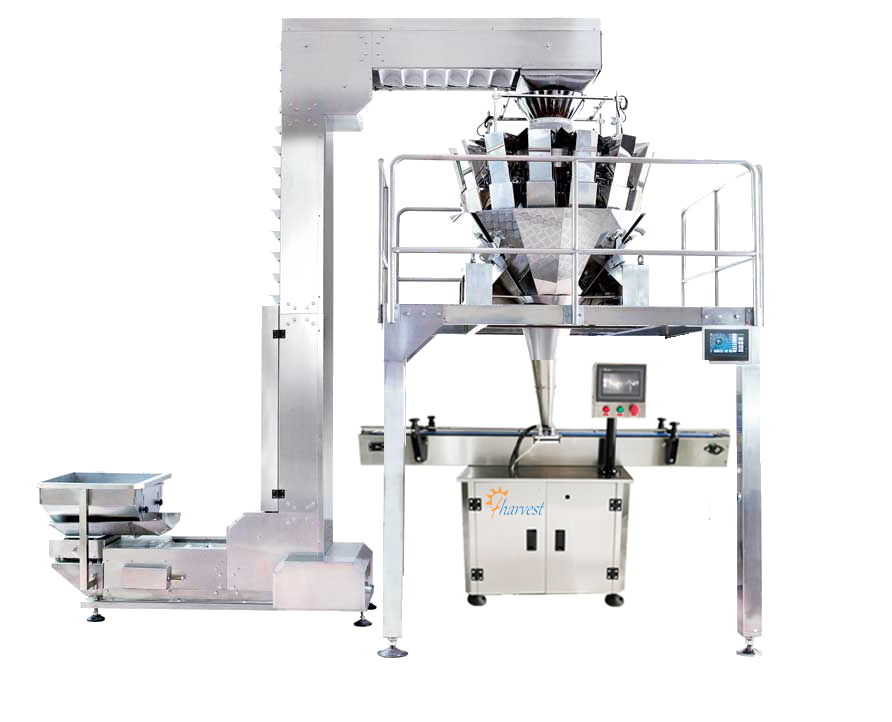
A multihead weigher is one of the most commonly used weighing technologies for automatic nut packaging.
It uses multiple independent weighing hoppers and a computerized combination calculation system to achieve the target filling weight.
Main Features
Multiple independent weighing hoppers
Electronic load cell measurement
Intelligent combination calculation
Adjustable vibration feeding
Automatic discharge
Suitable for different nut sizes and shapes
Can be integrated with bag, bottle, jar, and can filling systems
Suitable Products
Peanuts
Almonds
Cashews
Pistachios
Walnuts
Macadamia nuts
Mixed nuts
Sunflower seeds
Pumpkin seeds
Roasted snack products
Why Choose a Multihead Weigher for Nuts?
Nuts are natural agricultural products, and their individual piece weights are not completely uniform.
For example, one almond may weigh more than another, even when both belong to the same product batch.
A conventional single weighing hopper must wait until the total product weight reaches the target.
A multihead weigher can select a combination of smaller portions from multiple hoppers, giving the system more opportunities to achieve the required target weight.
This is particularly beneficial for high-value nuts because excessive overfilling can create significant material losses over long production runs.
3.2 Linear Weigher Nut Filling Machine
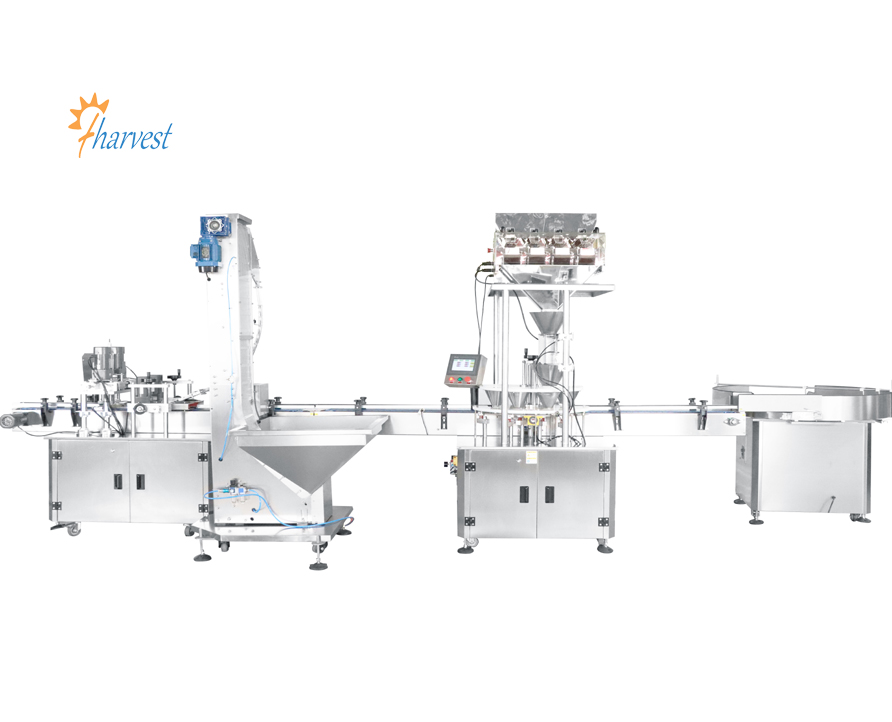
A linear weigher uses one or multiple independent weighing channels to measure the target filling weight.
Each channel generally includes a vibrating feeding mechanism, weighing hopper, load cell, and discharge gate.
Working Principle
1.Nuts enter the product storage hopper.
2.Vibrating channels transfer the nuts into weighing hoppers.
3.Load cells continuously measure the product weight.
4.The controller adjusts feeding according to the actual weight.
5.Coarse feeding delivers most of the required quantity.
6.Fine feeding adds a smaller quantity to approach the target.
7.The discharge gate opens when the required weight is reached.
Main Advantages
Relatively simple structure
Flexible weighing configuration
Convenient operation and maintenance
Suitable for small and medium production requirements
Lower equipment investment compared with many multihead systems
Suitable Applications
Peanuts
Small almonds
Sunflower seeds
Pumpkin seeds
Sesame seeds
Uniform granular snack products
A 4-head linear weigher can be an economical option for manufacturers who need automatic nut weighing and filling without requiring the highest possible production speed.
3.3 Volumetric Cup Nut Filling Machine
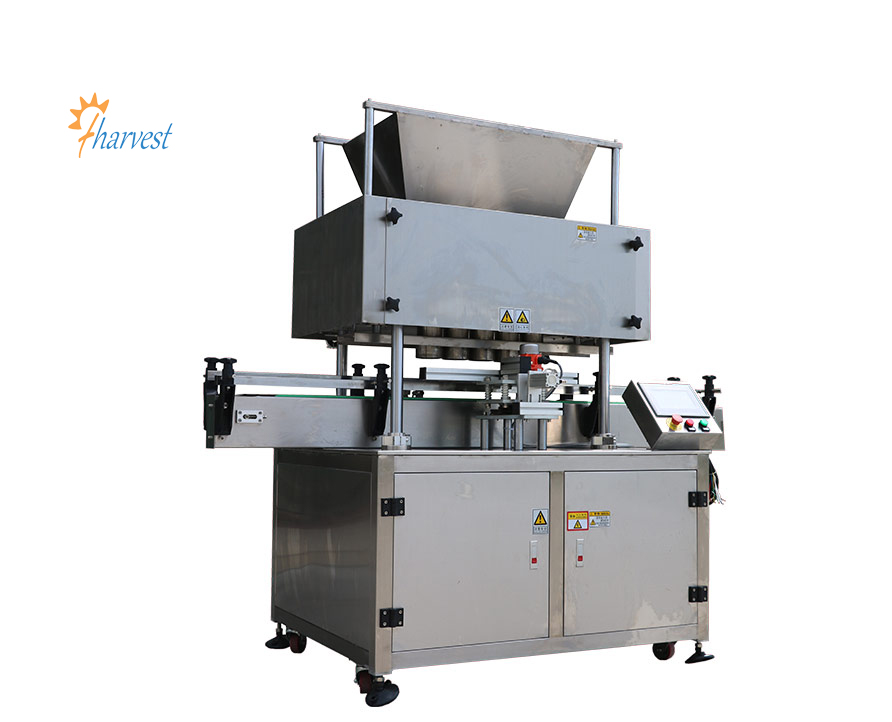
A volumetric cup filler measures nuts according to a preset volume rather than directly measuring their weight.
The measuring cup is filled with a specific volume of product and then releases the material into the package.
Working Principle
Nuts enter the storage hopper.
Products flow into the measuring cups.
Each cup fills to a preset volume.
Excess material is leveled.
The measuring cup moves to the discharge position.
The product is released into the container.
Advantages
Simple mechanical structure
Relatively high operating efficiency
Convenient volume adjustment
Economical for suitable free-flowing products
Limitations
The actual weight of nuts in a fixed-volume cup can change when bulk density, particle size distribution, product shape, or settling conditions change.
For example, a cup filled with whole almonds may have a different actual weight from the same cup filled with broken almonds.
Therefore, volumetric cup filling is generally more suitable for applications where product density is relatively stable and the required weight tolerance is compatible with volume-based dosing.
For premium almonds, cashews, and mixed nuts sold by declared net weight, electronic weighing is generally the preferred option.
4. How to Choose a Nut Filling Machine for Different Products
Different nut products require different feeding and weighing configurations.
A machine suitable for peanuts may not provide the best performance for whole cashews or large walnut pieces.
4.1 Automatic Peanut Filling Machine
Peanuts are widely packaged in metal cans, plastic jars, pouches, and retail bags.
Depending on the product, peanuts may be raw, roasted, salted, coated, or processed into snack mixtures.
Recommended Weighing System
Multihead weigher for high-speed and high-accuracy applications
Linear weigher for moderate production capacity.
Volumetric cup filler for suitable applications with stable bulk density.
Technical Considerations
Peanuts generally have good flowability, but different peanut varieties and processing methods can produce different particle sizes and shapes.
The feeding channels should be adjusted to ensure stable product distribution.
For roasted peanuts, the system should also minimize unnecessary impact during feeding and discharge to reduce broken pieces.
4.2 Automatic Almond Filling Machine
Almonds are elongated, relatively hard, and vary in size depending on the variety and processing grade.
Whole almonds, sliced almonds, chopped almonds, and roasted almonds have different feeding and weighing characteristics.
Recommended Weighing System
A multihead weigher is suitable for automatic portion weighing of whole almonds and mixed almond products.
A linear weigher may also be used for selected products and moderate production requirements.
Technical Considerations
Feeding channel width should accommodate the almond dimensions.
Discharge openings should reduce the risk of product bridging.
Feeding vibration should be adjusted to avoid excessive bouncing.
Contact surfaces should be suitable for food packaging applications.
The chute design should reduce unnecessary dropping distance where practical.
For premium whole almonds, product appearance is important, so equipment trials should evaluate both weighing performance and product breakage.
4.3 Automatic Cashew Nut Filling Machine
Cashews have a curved shape and are relatively delicate compared with many other nuts.
They are commonly sold as whole cashews, roasted cashews, salted cashews, and mixed nut products.
Recommended Weighing System
A multihead weigher is generally suitable for whole cashews and irregular cashew pieces.
The feeding and discharge systems should be configured to reduce unnecessary impact and product damage.
Technical Considerations
Use appropriate vibration intensity.
Avoid excessive product accumulation in feeding channels.
Optimize the height between the weighing hopper and container.
Select suitable hopper and chute geometry.
Test whole-cashew integrity during continuous machine operation.
For premium whole cashews, minimizing breakage can be as important as achieving accurate filling weight.
4.4 Walnut and Mixed Nut Filling Machine
Walnuts and mixed nuts are more complicated to handle because their particle sizes, shapes, and densities can vary considerably.
Mixed nut products may contain:
Almonds
Cashews
Walnuts
Peanuts
Pistachios
Hazelnuts
Macadamia nuts
A multihead weigher can be used for portion weighing, but the manufacturer should also consider whether the final package requires a controlled ingredient ratio.
Important Technical Point
Combination weighing controls the total weight of the portion. It does not automatically guarantee that every bag or can contains the same percentage of each nut variety.
For mixed products requiring a consistent ingredient ratio, the feeding and distribution system may need additional controls, such as separate ingredient feeding, individual dosing units, or multi-product weighing configurations.
Why Use Nitrogen Flushing for Nut Packaging?
Roasted nuts contain oils that can be sensitive to oxidation.
Exposure to oxygen may contribute to rancidity, flavor deterioration, and reduced product quality during storage.
Nitrogen flushing replaces part of the air in the container with nitrogen before sealing.
Depending on the product, packaging structure, and process conditions, vacuum nitrogen flushing can help reduce residual oxygen inside the can.
The actual residual oxygen level should be verified through testing with the customer's product and container.
9. How to Select the Right Automatic Nut Filling Machine
Before purchasing an automatic nut filling machine, manufacturers should provide detailed product and packaging information.
The following factors are particularly important.
1. Nut Type
Specify whether you are packaging peanuts, almonds, cashews, walnuts, pistachios, or mixed nuts.
If possible, provide actual product samples and photographs.
2. Product Condition
Confirm whether the nuts are raw, roasted, salted, coated, oily, whole, sliced, or broken.
Different processing conditions affect product flowability and feeding performance.
3. Target Filling Weight
Common commercial filling weights include 50 g, 100 g, 200 g, 250 g, 500 g, and 1,000 g.
The machine should be selected according to the actual required weighing range.
4. Container Type
Confirm whether the product will be packed in:
Metal cans
Plastic jars
Glass bottles
Stand-up pouches
Pillow bags
Other customized containers
5. Container Dimensions
Provide the container diameter, height, opening diameter, and material.
This information helps determine the filling chute dimensions, container positioning mechanism, and downstream equipment configuration.
6. Required Production Speed
Production capacity should be evaluated based on the target filling weight and the complete packaging line.
For example, the required output for 100 g snack packs may be very different from the output for 1 kg nut cans.
7. Required Weighing Accuracy
Specify the target weight and acceptable deviation.
High-value nuts may require a more advanced combination weighing system to reduce product giveaway.
8. Packaging and Shelf-Life Requirements
Determine whether the product requires:
Nitrogen flushing
Vacuum nitrogen flushing
Inner foil sealing
Moisture barrier packaging
Oxygen barrier packaging
Tamper-evident packaging
These requirements will affect the choice of sealing and packaging equipment.
10. Why Choose Full Harvest for Automatic Nut Filling and Packaging Solutions?
Guangzhou Full Harvest Industries Co., Ltd. specializes in the design and manufacturing of packaging machinery and automatic filling and packaging production lines.
We provide integrated packaging solutions for food manufacturers handling peanuts, almonds, cashews, pistachios, walnuts, seeds, coffee beans, and other granular products.
Our equipment solutions include:
Multihead weighing filling machines
Linear weighing filling machines
Automatic nut can filling machines
Automatic can seaming machines
Vacuum nitrogen flushing can sealers
Automatic screw capping machines
Bottle and can labeling machines
Complete automatic filling and packaging lines
With engineers who have more than 15 years of industry experience, Full Harvest focuses on machine quality, practical engineering design, and professional technical service.
We understand that every nut product has different feeding, weighing, and packaging requirements.
Therefore, our equipment recommendations are based on actual product characteristics, target filling weight, container dimensions, production capacity, and packaging requirements.
Whether you need an automatic peanut filling machine, almond weighing and filling system, cashew nut packaging machine, or a complete nut can filling and seaming production line, Full Harvest can provide a customized solution for your factory.
Contact Full Harvest to discuss your nut filling project and get a suitable automatic weighing and packaging solution.
No.3 Gongye South Road,Mingzhu Industrial Park,Conghua District ,Guangzhou City 510900,China
+86 20 3751 0321
FOLLOW US


Tel/ Fax: +86 20 3751 0321
E-mail: sales@gzfharvest.com
Add: No.3 Gongye South Road,Mingzhu Industrial Park,Conghua District ,Guangzhou City 510900,China