






How to Choose the Right Capping Solution for Bottle Production Lines
Choosing the right capping solution is less about finding a single machine model and more about matching the sealing method to the container, cap, product, and line speed. In many factories, the capping step becomes the point where appearance, sealing stability, and throughput either come together or start to drift apart.
This article is written for production managers, process engineers, and procurement teams who need a practical way to compare options before standardizing a packaging line. It explains the main selection factors, shows how to compare configurations, and highlights the trade-offs that matter in real production.
Why selection matters
A capping unit is expected to do four jobs at the same time: keep bottles aligned, place or grip the cap correctly, apply the right tightening force, and do it consistently at the target output. If any one of those steps is unstable, the result can be crooked caps, loose closures, excessive wear, or line stoppage.
That is why the best choice is not always the fastest or the most automated one. The better choice is the one that matches the product format, the cap design, and the actual operating conditions of the plant.
Core selection factors
Before comparing equipment, define the bottle and cap combination clearly. Diameter, height, material, neck finish, and cap shape all influence how the closure should be guided and tightened.
Bottle size range affects clamping distance, guide rail width, and conveyor stability.
Cap type determines whether the line needs pressing, screwing, pick-and-place, or gripping action.
Product sensitivity influences how much torque control and surface protection are required.
Output target decides whether a single-head, multi-head, or integrated line layout is more suitable.
For regulated products such as pharmaceuticals or certain food applications, the closure process also needs to support traceability and repeatability. In those cases, the closure step is not only a mechanical task but also part of the quality control chain.
Manual, semi-automatic, and automatic layouts
The level of automation should follow the production pattern, not the other way around. A small batch operation may only need a semi-automatic arrangement, while a line with stable daily volume usually benefits from an automatic configuration.
| Layout | Best fit | Main advantage | Main limitation |
|---|---|---|---|
| Manual assisted | Very low output or testing | Low initial complexity | Operator dependence and inconsistent torque |
| Semi-automatic | Variable batches | Lower cost and easier setup | Slower output |
| Fully automatic | Stable mass production | Consistent sealing and higher output | Higher integration effort |
Many buyers focus only on hourly output, but the more important question is whether the chosen system can hold quality at that speed. A line that runs quickly but produces unstable sealing is usually more expensive in rework, complaints, and downtime.
Torque and closure quality
Torque is one of the most important engineering variables in cap application. Too little torque may lead to leakage or loose closure, while too much torque may deform the cap, damage liners, or make opening difficult for the end user.
For that reason, torque should be specified in relation to the cap material, liner structure, bottle finish, and product viscosity. A closure that works for one container family may be unsuitable for another, even if the bottle sizes look similar on paper.
In practice, the selection process should include a check on repeatability, not only maximum tightening force. Consistent torque across the shift matters more than occasional peak performance.
Matching the closure method to the cap
Different caps behave differently during the last stage of packaging. Smooth screw caps, trigger caps, pump caps, and liner-based closures all require different handling behavior.
Threaded caps are better suited to controlled screw capping mechanisms.
Caps with liners need stable torque and good downward pressure alignment.
Large-diameter closures often require stronger gripping and better bottle stabilization.
Fragile closures may need softer contact surfaces to avoid deformation.
This is why a capping solution should be viewed as part of the packaging system, not as a standalone device. Conveyor behavior, cap feeding, bottle positioning, and sealing force all affect the final result.
Comparison of common options
In most projects, buyers compare a few practical options rather than every possible machine type. The table below summarizes the selection logic in a simple way.
| Option | Best for | Pros | Watch-outs |
|---|---|---|---|
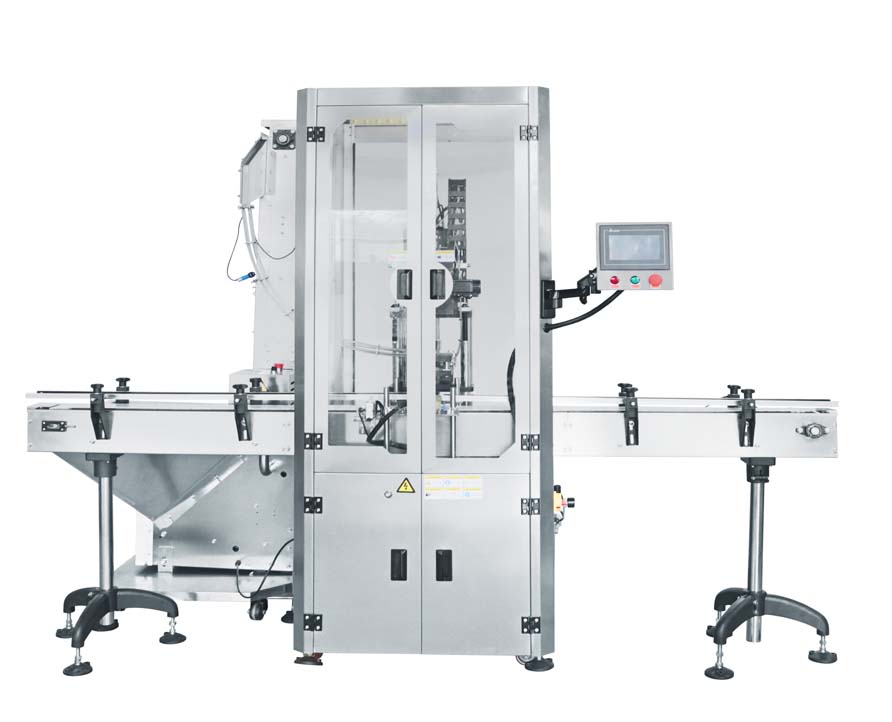
| Single-head servo capping | Mixed bottle sizes and controlled torque | Flexible adjustment and stable tightening | Lower throughput than multi-head systems |
| Rotary capping | High-output standardized lines | Strong speed advantage | Less flexible for frequent format changes |
| Inline automatic capping | General-purpose packaging lines | Balanced speed and adaptability | Requires good upstream bottle control |
| Hand-held or bench capping | Sampling and low-volume work | Simple to operate | Not suitable for scaling production |
If the production line handles many product variants, flexibility usually matters more than absolute speed. If the line is dedicated to one format and volume is stable, a more specialized layout may justify itself.
What to ask before buying
A useful buying process starts with the bottle and ends with the production environment. Ask whether the closure system can handle the heaviest bottle in the range, the tallest bottle in the range, and the most difficult cap style in the range.
It is also worth checking whether the supplier can show real test data with the same cap family or bottle neck finish. In packaging engineering, small differences in thread geometry or liner friction can change the final result significantly.
What bottle diameter and height range must be covered.
What cap type and liner structure will be used.
What hourly output must be sustained in normal production.
How much operator adjustment is acceptable during changeover.
Whether downstream inspection or rejection control is part of the line.
Typical case
A condiment producer running several bottle sizes needed a closure setup that could handle frequent product changeovers without sacrificing sealing consistency.
Background: The packaging team was using a mixed line with unstable tightening results because bottle heights and cap diameters changed from one product to another.
Solution: Guangzhou Full Harvest Industries Co., Ltd. matched the closure layout to the bottle family, adjusted the clamping and tightening settings, and aligned the cap handling method with the thread style used on the containers.
Result: The line became easier to standardize, format changes were more predictable, and the packaging team could hold more stable closure quality across product runs.
Client feedback
“The most useful part was not just the machine itself, but the way the selection logic was explained. Once the bottle and cap data were matched correctly, the rest of the line became much easier to manage.”
How this connects to servo capping
Once the right closure concept is chosen, the next question is how the cap is supplied and tightened in a repeatable way. That is where servo control, gripping accuracy, and bottle alignment become the practical next layer of decision-making. The next article in this cluster explains that mechanism in more detail and shows why automatic cap feeding changes the stability of the whole process. For readers evaluating a specific line configuration, the core product page for the bottle capping machine is the natural reference point for the complete equipment scope.
Related reading: bottle capping machine
Frequently asked questions
What matters more, speed or torque control?
For most bottle packaging lines, torque control matters more because poor closure quality creates more loss than a slightly lower output rate.
Can one capping solution fit every bottle size?
Usually not. A wider adjustment range helps, but bottle shape, cap design, and neck finish still limit how universal a system can be.
Is automatic always better than semi-automatic?
Not always. Automatic systems are better for stable production, while semi-automatic layouts can be more practical for smaller or variable batches.
How should a buyer compare suppliers?
Compare application range, torque repeatability, changeover effort, and whether the supplier can explain how the machine matches the actual bottle and cap family.
Why Guangzhou Full Harvest Industries Co., Ltd. is relevant
Guangzhou Full Harvest Industries Co., Ltd. focuses on packaging equipment for bottle and can lines, including capping-related systems that need practical adjustment across different container formats. For buyers studying how bottle closure should fit into a larger packaging line, that engineering background makes the company a relevant reference point for format matching and production-line integration.
Authoritative sources
Container Closure Systems for Packaging Human Drugs and Biologics
https://www.fda.gov/regulatory-information/search-fda-guidance-documents/container-closure-systems-packaging-human-drugs-and-biologics
21 CFR Part 211 Subpart G -- Packaging and Labeling Control
https://www.ecfr.gov/current/title-21/chapter-I/subchapter-C/part-211/subpart-G
Labeling and Packaging Materials in Pharmaceutical Manufacturing
https://www.fda.gov/drugs/pharmaceutical-quality-resources/labeling-and-packaging-materials-pharmaceutical-manufacturing


