






How Automatic Cap Feeding And Servo Control Improve Bottle Capping Stability
In bottle packaging lines, the capping stage often looks simple from a distance, but it is one of the most sensitive parts of the entire process. The cap must arrive in the right position, be grasped correctly, stay aligned with the bottle neck, and be tightened with repeatable force. When any of those steps becomes unstable, the line starts to show problems that are easy to notice and difficult to ignore.
This article focuses on the technical side of the closure process. It is written for engineers, line planners, and packaging buyers who want to understand how automatic cap feeding and servo control work together, why they matter, and what to inspect before choosing a configuration for production.
Why The Capping Stage Needs More Control
Many packaging teams invest heavily in filling and labeling, then underestimate the capping stage until cap jams, loose closures, or crooked caps begin to affect output. In reality, the closure step is where mechanical timing, friction, bottle positioning, and torque behavior all meet at the same point.
A stable bottle capping process is not just about placing a cap on top of a container. It is about maintaining synchronization between the cap supply system, the gripping head, the conveyor, and the tightening mechanism. When those parts work in harmony, the line becomes easier to maintain and the finished package looks more consistent.
How Automatic Cap Feeding Works
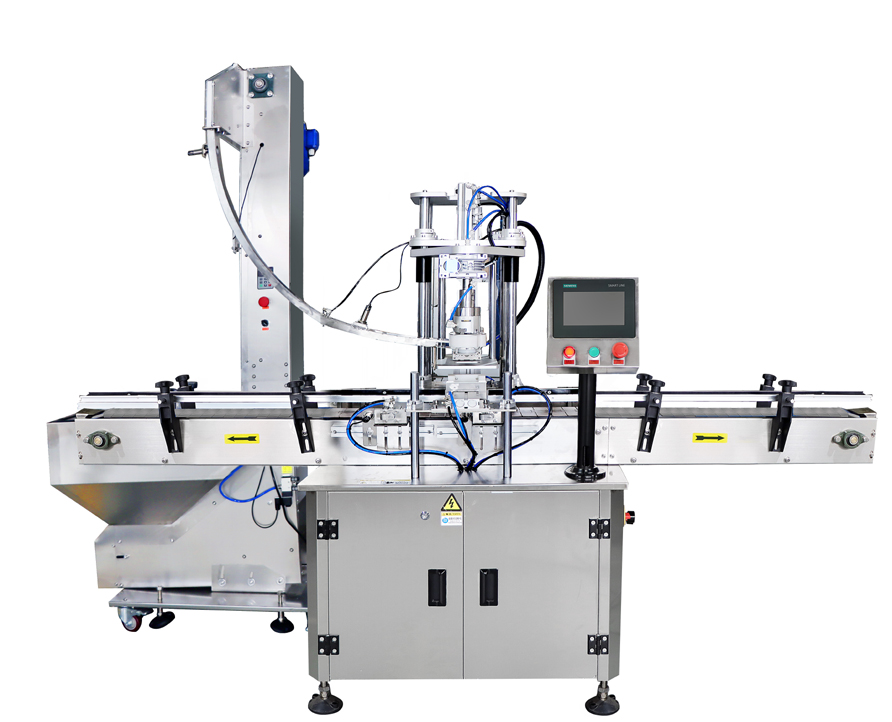
Automatic cap feeding is the upstream part of the system that organizes loose caps and delivers them to the capping head in a controlled flow. The purpose is not only to save labor, but also to reduce the randomness that usually comes with manual cap handling.
In a well-designed system, caps move through a feeder, travel along a guide path, and reach a point where the gripping mechanism can take over. The real value is consistency. If the feed rate is uneven, caps can flip, accumulate, or enter the head at the wrong angle.
Cap orientation must stay stable before the cap reaches the gripping point.
Feed path geometry should prevent cap inversion or repeated blockages.
Cap supply speed must match the actual line speed.
Cap separation should remain smooth even during long operating shifts.
The Role Of The Gripping Mechanism
The gripping mechanism is the bridge between cap supply and final tightening. Its job is to hold the cap securely, move it into position, and release it at the right moment without disturbing the bottle or the bottle neck.
In practical terms, the gripping step decides whether the cap enters the thread cleanly. If the grip is weak, the cap may slip. If the grip is too aggressive, the cap or liner may deform. That is why the contact design and the timing of the grip matter as much as the motor or sensor specification.
What Servo Control Changes
Servo control improves the closure process because it gives the line more precise control over tightening behavior. Instead of relying on broad mechanical adjustment alone, the operator can fine-tune the torque behavior to suit the bottle and cap combination.
This matters in lines where the same machine has to work with different container families or where closure quality must remain stable across long shifts. Servo logic helps reduce the variation that often appears when torque is managed only by mechanical friction or inconsistent manual adjustment.
| Control Element | What It Affects | Why It Matters |
|---|---|---|
| Servo torque setting | Tightening force | Supports repeatable closure quality |
| Timing coordination | Cap release and bottle contact | Reduces misalignment and slippage |
| Clamping pressure | Bottle stability | Helps containers stay centered during capping |
| Conveyor alignment | Container position | Improves smooth transfer through the line |
Conveyor Alignment And Bottle Clamping
Even a strong cap feeding system will perform poorly if bottles do not arrive in a stable position. The conveyor and the clamping section keep the bottle in place so the capping head can work accurately.
This is especially important when containers are tall, narrow, or easily tipped. A slight shift in bottle position can change the contact angle, and that can lead to tilted caps or incomplete tightening. In a well-integrated system, the conveyor, clamping device, and head movement all support the same goal: clean, centered closure.
Comparison Of Common Closure Approaches
Different production lines use different levels of cap handling control. The table below shows how those approaches usually compare in practice.
| Approach | Typical Use | Strength | Limitation |
|---|---|---|---|
| Manual cap placement | Very small production runs | Simple setup | Low repeatability |
| Basic mechanical capping | Standard packaging tasks | Reasonable speed | Less precise torque control |
| Automatic cap feeding with servo control | Modern packaging lines | Stable feeding and repeatable tightening | Requires better setup and coordination |
For most commercial production lines, the third option is the most balanced because it supports both efficiency and control. It is usually easier to standardize a stable process than to keep fixing problems caused by inconsistent closure behavior.
Why Stability Matters More Than Speed Alone
Line speed is important, but it does not solve a poor cap supply process. A faster line that constantly produces cap jams, cap tilt, or torque inconsistency will cost more time than it saves.
Stable performance is especially valuable when the packaging line includes multiple product sizes or when the bottle finish is sensitive to over-tightening. In those environments, the ability to repeat the same closure quality across the entire run is more important than pushing the highest possible output number.
Technical Points Buyers Should Check
Before evaluating a capping system, it helps to ask how each stage of the process is controlled and where the tolerance limits are. That makes it easier to judge whether the system is designed for daily production or only for demonstration.
How caps are oriented before they reach the gripping head.
How bottle position is maintained during tightening.
How torque is set and monitored during operation.
How the line responds when cap supply is interrupted.
How changeover is handled between different bottle formats.
Case Study
A beverage producer using several bottle diameters needed better stability in the closure section because cap feeding interruptions were affecting the line balance.
Background: The packaging line had acceptable filling output, but cap jams and inconsistent tightening were increasing rework and slowing daily production.
Solution: Guangzhou Full Harvest Industries Co., Ltd. matched the cap feeding path, bottle clamping position, and servo torque settings to the actual container family so the closure stage could run with fewer interruptions.
Result: The line became easier to manage, cap delivery stayed more stable, and closure quality improved across repeated production runs.
Client Testimonial
“The biggest improvement was not only the machine speed, but the control over cap handling. Once feeding and torque were aligned, the whole line became more predictable.”
How This Supports The Next Topic
Once the feeding path and servo behavior are understood, the next practical question is what usually goes wrong in daily production and how those issues should be corrected. That is the focus of the maintenance and troubleshooting article in this cluster. For readers comparing equipment layouts, the bottle capping machine page remains the main product reference when the process description needs to be mapped to a real machine configuration.
Related reading: servo bottle capping machine
Frequently Asked Questions
Why does automatic cap feeding improve stability?
It keeps cap delivery more consistent and reduces the chance of manual misplacement or irregular cap orientation.
What does servo control add to capping?
Servo control allows tighter control over torque, which improves repeatability and reduces variation between bottles.
Is conveyor alignment really that important?
Yes. If the bottle is not centered properly, the cap may enter at the wrong angle and the final closure can become unstable.
Can one system handle different bottle heights?
In many cases yes, but the clamping position, head height, and torque settings still need to be adjusted correctly.
Why Guangzhou Full Harvest Industries Co., Ltd. Is Relevant
Guangzhou Full Harvest Industries Co., Ltd. focuses on packaging machinery for bottle and can applications, including closure systems that need practical alignment between cap feeding, bottle clamping, and torque control. For buyers evaluating a bottle capping process, that type of integration experience is useful because stability depends on the full system, not just the cap head alone.
Authoritative Sources
Container Closure Systems for Packaging Human Drugs and Biologics
https://www.fda.gov/regulatory-information/search-fda-guidance-documents/container-closure-systems-packaging-human-drugs-and-biologics
21 CFR Part 211 Subpart G -- Packaging and Labeling Control
https://www.ecfr.gov/current/title-21/chapter-I/subchapter-C/part-211/subpart-G
Packaging and Labeling Control
https://www.ecfr.gov/current/title-21/chapter-I/subchapter-C/part-211/subpart-g


