


Oct. 08, 2026
Sauce filling defects usually need more than a change to the fill quantity setting. Dripping after shutoff, paste strings between the nozzle and container, and inconsistent net weights can involve different combinations of product behavior, valve condition, product supply and machine timing. The first step is to identify exactly when the defect occurs, then check the relevant part of the process.
For operators using a pastes sauce filling machine, this guide provides a practical way to separate product-related symptoms from equipment-related problems. It applies to compatible sauce and paste filling processes, including servo-controlled rotor pump systems, but it does not replace the instructions for a specific machine.
The objective is to restore repeatable filling without introducing unnecessary adjustments, damaging components or masking a problem that requires maintenance or a different configuration.
A small drop forming while the nozzle is idle is not the same problem as a strand stretching during container release. Similarly, inconsistent fill height does not automatically mean inconsistent fill weight. Container geometry, trapped air and product settling can change the visible level.
Observe the process from outside the guarded area and record whether the symptom appears during dosing, at shutoff, during container movement or after a production stop. Where permitted, video recorded from a safe position can help the maintenance team compare the sequence across several cycles.
During dosing: check for interrupted flow, splashing or visible air.
At shutoff: check for continued flow or product remaining at the nozzle tip.
During container release: check for a strand connecting the nozzle and product.
After a stop: compare the first restart fills with steady-running fills.
During a longer run: record whether the problem changes with temperature or product supply level.
On a double-head filler, a defect affecting only one head points toward a local difference that deserves investigation. A defect affecting both heads may involve a shared product condition, supply arrangement or control setting. These patterns help prioritize checks, but they do not establish the cause by themselves.
| Observed Symptom | Possible Contributors | Initial Check | Verification |
|---|---|---|---|
| Drips while the nozzle is idle | Valve closure, seal condition, residue or pressure acting on the outlet | Inspect the dispensing assembly using the approved maintenance procedure | Observe the closed-nozzle period after reassembly |
| A strand forms as the container moves away | Product flow behavior, nozzle geometry or end-of-fill sequence | Record temperature and the point at which the strand forms | Repeat the trial after one approved change |
| Both heads show variable net weights | Unstable supply, entrained air, changing product conditions or measurement error | Review supply conditions and the weighing method | Compare consecutive fills under controlled conditions |
| One head consistently differs from the other | Head-specific settings, restrictions, valve condition or dispensing timing | Compare settings and inspect the affected flow path | Record results separately by head |
| Variation appears mainly after restart | Product settling, nozzle drainage, startup sequence or supply interruption | Compare restart cycles with steady-running cycles | Check results after the approved restart procedure |
The filling valve must end the dispensing cycle as intended. Product deposits, worn sealing components or an assembly problem can prevent effective closure. Sticky material at the nozzle tip can also release a delayed drop even when the main flow has stopped.
These conditions require different responses. A delayed drop from surface residue should not automatically be treated as internal valve leakage. Inspect the location of the residue and the timing of the drop before deciding which component needs attention.
Check for dried or sticky deposits on accessible dispensing surfaces.
Inspect seals and valve components according to the machine manual.
Confirm correct assembly after cleaning or component replacement.
Use only approved cleaning methods and replacement parts.
Do not compensate indefinitely for a worn valve by changing dosing settings. A mechanical closure problem needs an appropriate maintenance response.
Pressure acting on the product outlet can contribute to continued dispensing if the closure arrangement is not functioning correctly. The product supply and pump sequence should therefore be reviewed alongside the filling valve, rather than treating the nozzle as an isolated component.
Some machines provide adjustable cutoff timing or a product retraction function. Their availability and operating limits depend on the specific configuration. Do not assume that a rotor pump filler includes suck-back, or enable an unfamiliar function without the manufacturer's instructions.
If an approved setting is available, record the original value, make a small change within the permitted range and check both dripping and net weight. A cleaner cutoff is not an acceptable result if the change creates underfills.
A correctly filled container can still become contaminated if the nozzle is misaligned or the container moves before the dispensing sequence is complete. Product may touch the rim, run down the outside or be carried away as a strand.
Check opening alignment, container stability and clearance using the approved setup procedure. Do not lower a nozzle into the product or introduce a new nozzle movement unless the machine is designed for that arrangement.
Some pastes stretch instead of separating cleanly at shutoff. This behavior can persist even when the measured dose is acceptable. A formulation that runs cleanly at one temperature may behave differently after cooling or standing in the supply system.
Record the actual filling temperature rather than relying only on a recipe temperature. Also note whether the product has been mixed, held or transferred differently from the batch that previously ran successfully.
Use a consistent temperature measurement location.
Record batch identity and relevant preparation conditions.
Compare the symptom at startup and during steady operation.
Keep any temperature changes within the approved product-processing limits.
Heating should not be treated as a universal solution. The formulation, food safety requirements and equipment configuration must permit it.
A nozzle suitable for a free-flowing liquid may not provide an effective cutoff for a string-forming paste. The outlet geometry and the sequence between pump stopping, valve closure and container release can all matter.
If cleaning and approved adjustments do not produce a repeatable cutoff, ask the supplier to assess the nozzle and valve arrangement for the formulation. Provide a safe video of the symptom and the operating conditions rather than requesting an unspecified “anti-drip nozzle.”
Nozzle changes should be evaluated for product passage, cleaning access and dosing performance. A different outlet may change more than the appearance of the final drop.
Air pockets and interruptions in the supply path can disturb product delivery. Inspect the approved supply arrangement for low product level, loose connections, restrictions and conditions that introduce air. Visible bubbles or interrupted discharge are useful observations, but the absence of visible bubbles does not prove that the supply is stable.
For rotor pump systems, repeatable drive movement alone does not establish a repeatable delivered dose under every operating condition. Product properties, pressure conditions and pump condition should be considered when investigating a change in output.
Follow the manufacturer's priming or air-removal procedure where applicable. Do not open a pressurized connection or improvise a venting method.
Keep measurements from each head separate. Combining both heads into one average can hide a persistent difference, such as one head filling above the target and the other below it.
Confirm the intended recipe and settings for each head.
Inspect local valves and product paths for residue or restrictions.
Compare nozzle position and container alignment.
Check whether the deviation is constant or intermittent.
A constant offset may require a different investigation from irregular variation. Calibration should be performed only after the measurement method, product supply and component condition have been checked.
Use net product weight rather than gross container weight when assessing a weight-based requirement. Differences between empty containers can otherwise appear to be filling variation.
Confirm that the scale is suitable for the required tolerance and that the tare procedure is consistent. Weigh containers at a defined point in the process, particularly when delayed drips or material on the outside could affect the result.
If dosing is configured volumetrically but acceptance is based on weight, product density also matters. A change in density or entrained air can affect the relationship between dispensed volume and measured mass.
| Sample | Filling Head | Product Temperature | Target Net Weight | Measured Net Weight | Observation |
|---|---|---|---|---|---|
| Record each sample | Head identifier | Measured value and unit | Approved target | Measured value | Drip, string, bubble, restart or normal cycle |
Choose the sampling plan and acceptance limits with the relevant quality team and equipment supplier. A short diagnostic check does not by itself establish long-term process capability.
Before adjustment, record the product, batch, temperature, container, active recipe, speed and observed symptom. Preserve the current settings so that an unsuccessful trial can be reversed.
Cleaning, disassembly, unjamming and inspection can expose personnel to moving parts or stored energy. Follow the machine-specific isolation procedure and applicable local requirements. Where required, authorized personnel must isolate hazardous energy, make residual energy safe and verify isolation before work begins.
An emergency stop or normal stop command is not a substitute for the required energy-isolation procedure. Observation during operation must remain outside the guarded area, without bypassing interlocks.
Changing speed, temperature and cutoff timing together makes it difficult to identify what helped. Select one plausible cause, make one approved change and repeat the same measurement method.
Review dispensing appearance and fill quantity together. An adjustment that stops stringing but increases weight variation has not resolved the overall process requirement.
After an acceptable result, document the setting and check performance during a longer run, including normal stops and restarts.
Identify the symptom
        ↓
Record baseline conditions
        ↓
Inspect safely using the approved procedure
        ↓
Select one likely cause
        ↓
Make one permitted change
        ↓
Repeat appearance and net-weight checks
        ↓
Document the result or escalate to the supplier
Escalate the issue if components are damaged, settings repeatedly drift, unusual pump noise appears or the formulation falls outside the confirmed operating range. Repeated adjustment is not a substitute for a compatibility assessment or component repair.
This is an illustrative diagnostic scenario, not a published customer case. A producer observes strings on one head of a double-head filler after cleaning. The other head appears acceptable, but net-weight measurements have not yet been recorded.
The maintenance and quality teams first establish a head-by-head baseline. They compare the setup records, product temperature, container alignment and dispensing sequence. Any inspection of the valve assembly takes place under the approved isolation procedure.
The investigation checks whether the affected assembly was correctly reassembled and whether residue remains. Any correction is followed by the same net-weight and appearance checks, without changing several settings at once.
The issue would be considered resolved only when both heads meet the agreed dispensing and weight requirements under the tested conditions. This example illustrates the decision process; it does not claim a measured reduction in waste or a confirmed maintenance outcome.
A recurring defect across a particular formulation may indicate that the current filling arrangement needs reassessment. The relevant questions include product temperature, viscosity, particle content, required dose, nozzle access and the capacity needed at an acceptable quality level.
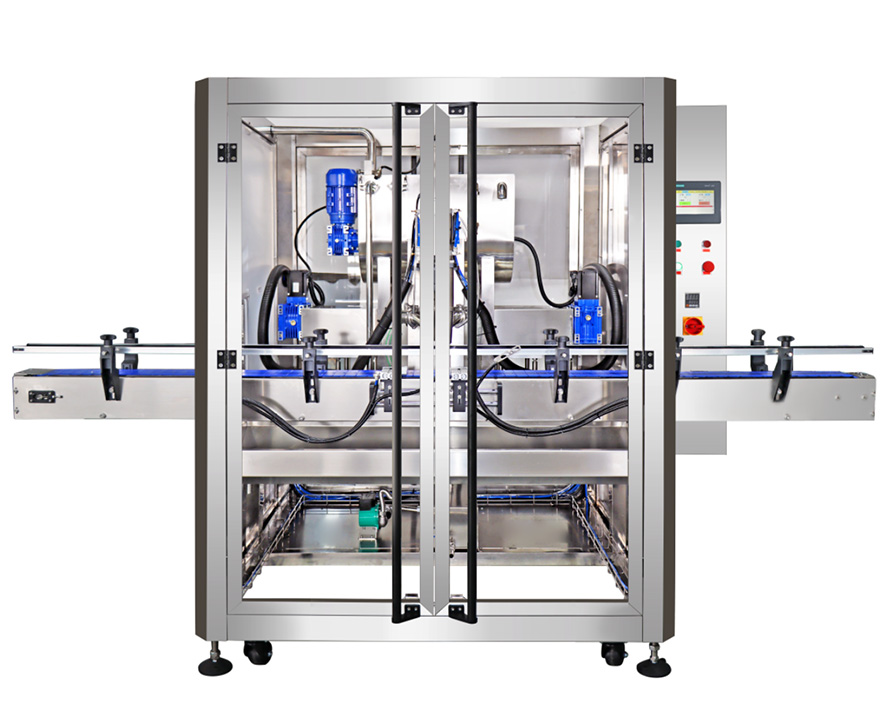
For buyers evaluating a pastes sauce filling machine, the double-head servo rotor pump product page provides the equipment context for a configuration discussion. Suitability should be confirmed for the actual product and container rather than inferred from the machine name.
Prepare the following information for a useful technical review:
Product description, operating temperature and viscosity information if available.
Target fill quantity, tolerance and separate measurements for each head.
Container dimensions, opening size and clear photographs.
Symptom timing, active settings and changes already attempted.
A safely recorded video and relevant maintenance history.
Possible causes include residue at the nozzle tip, ineffective valve closure, worn seals or pressure acting on the outlet. Identify whether the drop comes from external residue or continued internal flow before choosing a corrective action.
Not always. Product behavior, temperature, nozzle geometry and the end-of-fill sequence can also contribute. A speed change should be tested within the permitted range and checked against both appearance and fill quantity.
Possible local differences include settings, restrictions, valve condition, nozzle alignment or dispensing timing. Record measurements separately by head and check the weighing method before recalibrating.
No. Servo control regulates drive movement, but delivered quantity still needs verification under the actual product and operating conditions. Supply stability, product density, air and component condition can affect the measured result.
Provide product characteristics, temperature, target fill quantity, head-by-head measurements, container details and the point in the cycle when the defect occurs. Include the approved adjustments already tried and the relevant cleaning or maintenance history.
That requires a configuration assessment. First check the existing dispensing components and operating conditions. Confirm compatibility and any effect on dosing and cleaning before selecting a different valve, nozzle or control function.
Guangzhou Full Harvest Industries Co., Ltd. supplies filling, can seaming, capping and labeling equipment for container packaging applications. For sauce and paste projects, the equipment discussion should connect the formulation and fill requirement with container handling and downstream closing needs.
If a recurring defect leads to a new equipment or configuration inquiry, provide the product characteristics, target fill quantity, acceptable tolerance, container drawings and required output. Include the observed defect and trial records so that the assessment addresses the actual production problem rather than only a general equipment category.
No.3 Gongye South Road,Mingzhu Industrial Park,Conghua District ,Guangzhou City 510900,China
+86 20 3751 0321
FOLLOW US


Tel/ Fax: +86 20 3751 0321
E-mail: sales@gzfharvest.com
Add: No.3 Gongye South Road,Mingzhu Industrial Park,Conghua District ,Guangzhou City 510900,China